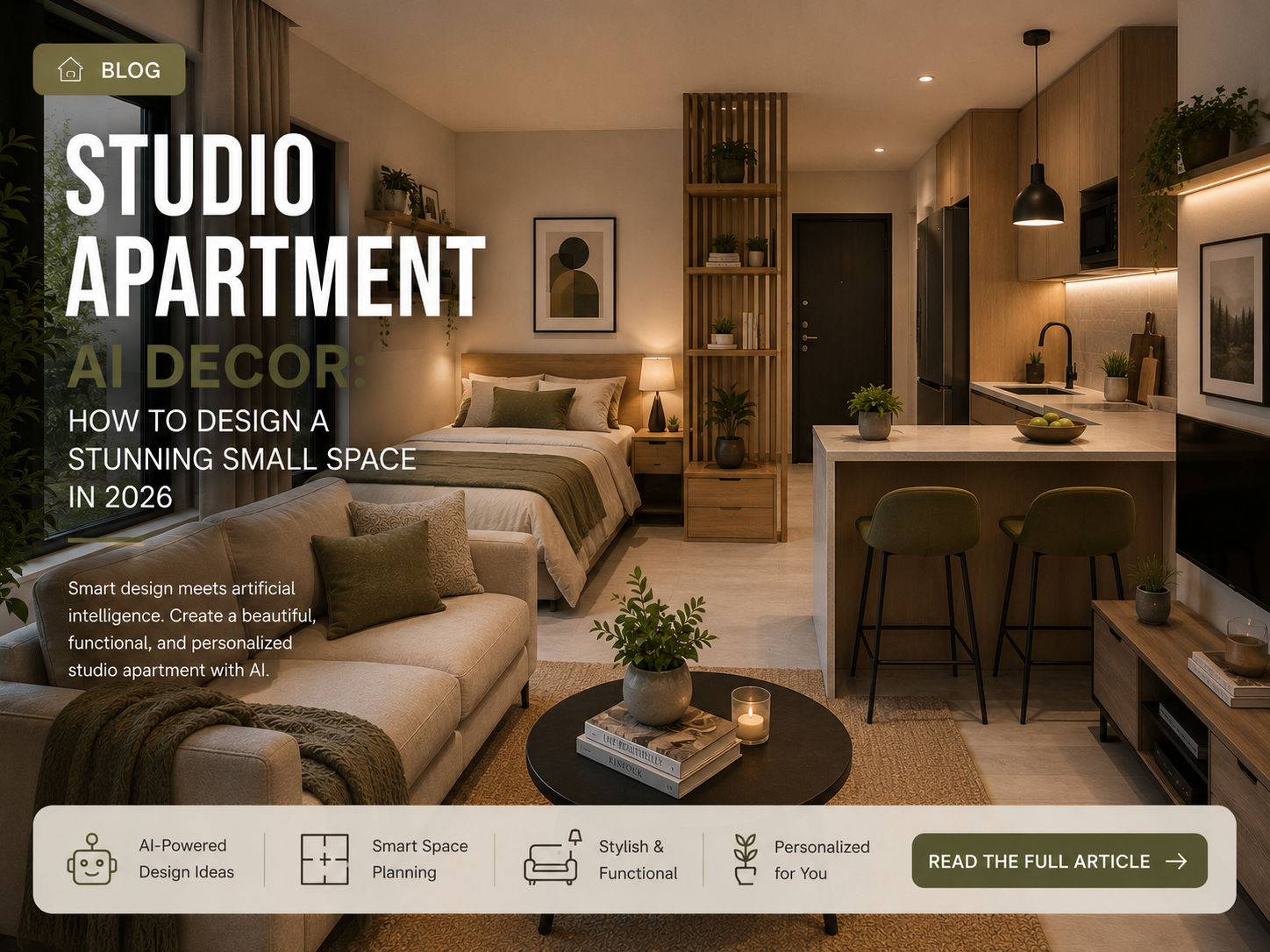
Living in a studio apartment in 2026 is no longer a compromise. What was once considered a temporary arrangement or a budget necessity has evolved into a deliberate lifestyle choice — one that prioritises location, efficiency, and intentional living. But designing a studio apartment well is genuinely hard. Every square foot has to work twice as hard, every furniture choice carries real consequences, and the margin for error is almost nonexistent.
This is exactly where AI decor for studio apartments changes the game. Instead of spending months trial-and-erroring furniture arrangements and colour combinations, AI room design tools give you a photorealistic view of your finished space before you move a single piece of furniture or paint a single wall.
1. Why Studio Apartments Need AI Design More Than Any Other Space
In a two-bedroom flat, a poor furniture choice in the guest room is an inconvenience. In a studio apartment, a poor furniture choice in the wrong corner can make the entire space feel unliveable.
Studio apartments present a unique set of design challenges that AI tools are exceptionally well-suited to solve.
The first challenge is zoning. A studio has to function simultaneously as a bedroom, a living room, a dining room, and often a home office — all within a single open space. Without clear visual and spatial zoning, the room feels chaotic and purposeless. AI studio apartment design tools analyse your floor plan and generate zone configurations that create the perception of separate rooms using furniture placement, rugs, lighting, and partial dividers — without building a single wall.
The second challenge is scale. Most people significantly overestimate how much furniture a small space can hold. An AI room planner for small apartments will flag when a sofa is too deep for the room, when a dining table will block a natural traffic path, or when a bed frame is consuming floor space that a storage platform bed could reclaim.
The third challenge is light. Studio apartments often have limited window access. AI decor tools factor in your window positions and orientations to recommend mirror placements, light-coloured surfaces, and artificial lighting strategies that make the space feel significantly larger and brighter than it physically is.
2. Smart Zoning Strategies AI Tools Recommend for Studios
The single most transformative thing you can do in a studio apartment is create clearly defined zones. AI interior design tools for studio apartments consistently recommend the following zoning strategies.
The rug anchor method is the most effective and lowest-cost zoning tool available. Placing a large rug — ideally 8 x 10 feet or larger — beneath your sofa and coffee table visually separates the living area from the sleeping area even when the two zones are only a few feet apart. AI room designers will map the exact rug dimensions and position that work for your specific floor plan.
Room dividers and open shelving units placed perpendicular to the wall create a physical separation between zones without blocking light or making the space feel closed in. An AI studio apartment planner will recommend the optimal height — typically 150 to 160cm — that divides the space without cutting off ceiling sight lines.
Ceiling treatment differentiation is an advanced strategy that AI tools are increasingly recommending for studios. Painting the ceiling above the sleeping zone in a slightly warmer or deeper tone than the rest of the room creates a subconscious sense of enclosure that mimics the feeling of a separate bedroom — without any structural work.
3. AI Furniture Recommendations for Studio Apartments
Furniture selection in a studio apartment is not about finding the smallest possible pieces. It is about finding pieces that perform multiple functions without looking utilitarian or compromising on aesthetics. AI decor tools for small spaces are trained to surface multi-functional furniture that matches your style preferences.
The most consistently recommended pieces by AI studio apartment design tools in 2026 include the following.
Storage platform beds with integrated drawers eliminate the need for a separate chest of drawers, reclaiming significant floor space. AI tools will calculate exactly how many litres of storage your current wardrobe requires and recommend bed storage configurations that meet that need.
Extendable dining tables that seat two at rest and expand to seat six for guests are a studio essential. An AI room planner will position this table in the precise spot where extension clearance is available without blocking movement through the space.
Sofa beds have improved dramatically in comfort and design by 2026. AI tools now cross-reference your sleep preferences, mattress thickness requirements, and daytime aesthetic preferences to recommend sofa bed models that do not look or feel like a compromise in either mode.
Wall-mounted desks that fold flat when not in use are the AI-recommended home office solution for studios. The tool will identify the wall with the best natural light access and the least interference with other zones and mark it as the optimal desk mounting point.
4. Colour Strategy for Studio Apartments: What AI Tools Recommend
Colour is the most powerful and most misunderstood tool in small space design. The conventional advice — paint everything white to make it feel bigger — is outdated and, frankly, wrong. AI colour tools for studio apartments take a far more nuanced approach.
Tone-on-tone decorating, where walls, furniture, and soft furnishings are kept within the same colour family but in varying shades and textures, creates a cohesive visual flow that makes a small space feel intentional and expansive rather than cramped. An AI palette generator will produce a full tone-on-tone scheme tailored to your room's light conditions and orientation.
Contrast zoning uses a single deeper or bolder colour on the wall behind the bed to anchor the sleeping zone visually. This does not make the room feel smaller — it makes it feel purposeful. AI tools will recommend the exact shade, factoring in your window light, to ensure the contrast reads as deliberate rather than heavy.
Warm neutrals consistently outperform cool whites in small spaces. Colours like warm putty, soft clay, aged linen, and pale terracotta reflect light with a warmth that cool whites cannot replicate, and they make surfaces appear to recede gently rather than close in.
5. Lighting Design for Studio Apartments: The AI Approach
Lighting in a studio apartment has to do the heavy lifting that architecture cannot. A well-lit studio feels twice the size of a poorly lit one, regardless of square footage. AI home decor tools for studio apartments generate a complete lighting layer plan that includes the following.
Ambient lighting from a central ceiling fixture provides general illumination but should never be the only light source in a studio. AI tools will flag if your current setup relies entirely on overhead lighting and recommend supplementary sources.
Floor lamps placed in corners draw the eye outward toward the perimeter of the room, which creates the optical illusion of a wider space. An AI room designer will mark the two or three corner positions in your specific layout that will have the greatest spatial impact.
Under-cabinet and shelf lighting in the kitchen zone adds depth and separates the kitchen visually from the living area at night, reinforcing the zoning effect without any physical division.
Bedside pendant lights or wall-mounted reading lamps replace bedside table lamps, freeing up surface space and keeping the sleeping zone feeling uncluttered.
6. Real Results: What AI Decor Tools Deliver for Studio Apartments
The practical output of using an AI interior design tool for your studio apartment goes well beyond a pretty render. You receive a complete, actionable design brief that includes a scaled furniture layout with exact dimensions and clearances, a curated furniture shortlist filtered by your budget and style preferences, a full colour palette with paint codes and material specifications, a lighting plan with fixture type and placement recommendations, and a zoning strategy with rug dimensions, divider positions, and ceiling treatment notes.
This brief can go directly to a furniture retailer, an interior painter, or a contractor — cutting weeks of back-and-forth out of the renovation process.
7. Studio Apartment AI Decor Styles That Are Trending in 2026
AI design tools are seeing a significant spike in certain aesthetic requests for studio apartments this year. The most popular studio apartment decor styles being generated through AI room designers in 2026 include Japandi minimal, which uses low-profile furniture, warm wood tones, and a restrained palette to make small spaces feel calm and considered. Coastal grandmother is another rising trend, bringing soft linens, natural textures, and warm whites into compact spaces with a relaxed, collected feel. Dark and moody maximalism — once considered impossible in small spaces — is being reimagined for studios through tone-on-tone deep palettes and strategic lighting that creates intimacy rather than claustrophobia. For more on maximizing layout, see How to Decorate a Small Living Room: 15 Smart Ideas.
Start Designing Your Studio Apartment Today
A small footprint does not mean a small vision. With the right AI decor tools, your studio apartment can be as considered, beautiful, and functional as any full-sized home.
Try our free AI room designer and upload a photo of your studio to receive a complete, personalised design brief — layout, colour palette, furniture recommendations, and lighting plan — in under twenty minutes.